

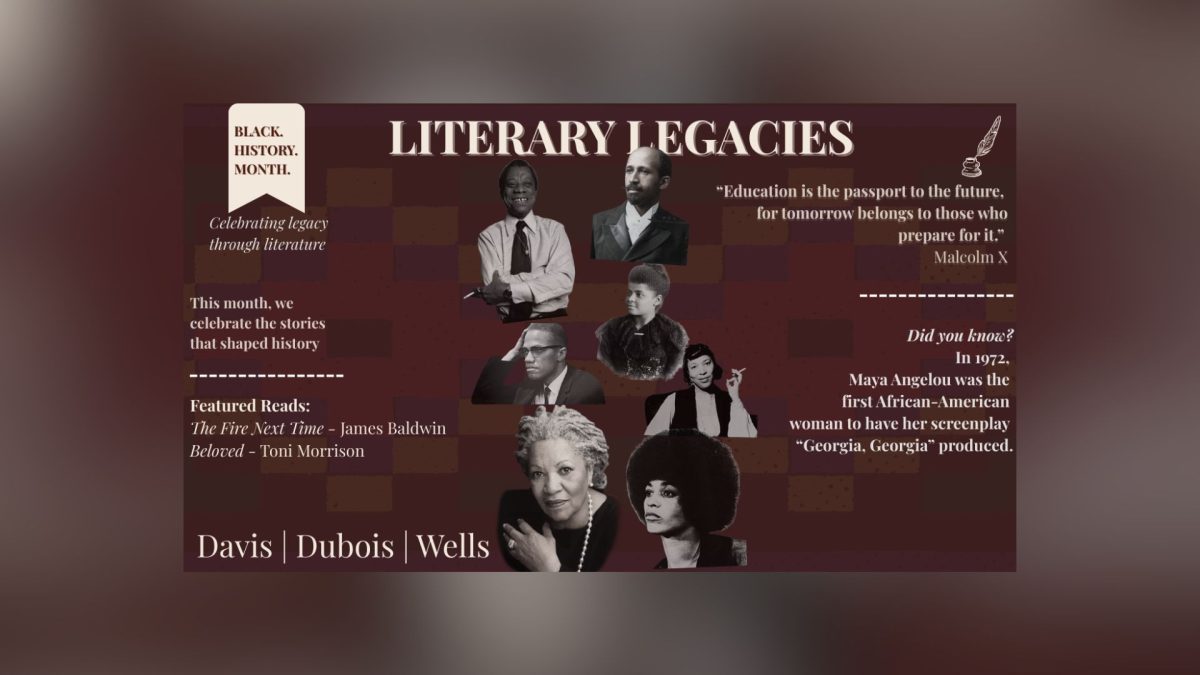
Black History Month is not only about honoring the past; it’s also about critiquing the systems that shape the present. Too often, institutions celebrate Black history through surface-level acknowledgments while avoiding the voices that most clearly articulate its realities. Literature has long been one of the most powerful tools for preserving Black history, challenging injustice and giving voice to experiences that have been ignored or deliberately erased.
For generations, Black authors have used literature as both a means of survival and a form of resistance. When Black voices were excluded from classrooms, publishing houses and historical records, they became writers who created their own intellectual traditions through essays, novels and criticism. These works offered language for experiences shaped by enslavement, segregation and the way Black identity has been shaped in a society that has repeatedly denied it.
Through essays, novels and critical analysis, Black authors challenge the limits of what is considered acceptable to say and imagine. Each narrative captures a moment of defiance, exposing contradictions and pushing movements to confront their own shortcomings. Engaging with Black writers and their writings is not simply an act of cultural appreciation. It’s an engagement with knowledge produced under conditions of exclusion and struggle.
The books that follow are not relics of a finished story because revolutions never remain static. In an ever-changing revolution, Black writers continue to leave a lasting imprint, one that continues to shape political thought, cultural expression and collective memory.
“Caste: The Origins of Our Discontents” by Isabel Wilkerson
Pulitzer Prize-winning journalist Isabel Wilkerson explores racism in the United States by comparing it to caste systems around the world. Drawing on history, sociology, and personal narratives, Wilkerson examines Western racial hierarchies in “Caste: The Origins of Our Discontents” and reframes racial inequality as stemming from a structured system rather than a series of personal failures.
Wilkerson’s work challenges readers to examine structure over intent and institutions over isolated actions. These contemporary analyses invoke national conversations about inequality by insisting that injustice is systemic, not accidental.
“Women, Race and Class” by Angela Davis
Where Wilkerson focuses on social structure, Angela Davis sharpens the lens on intersectionality. In “Women, Race and Class,” Davis, a scholar and activist whose work bridges academia and organizing, critiques liberation movements that fail to account for the overlapping forces of racism, sexism and economic exploitation.
By centering Black women’s roles in early feminist and abolitionist movements, Davis exposed how narrow approaches to progress leave the most vulnerable behind. With the suffrage movement centering on white women and the patriarchal approaches to the abolitionist movement, it was difficult for 19th-century Black women to find spaces that were centered on their needs.
“Ain’t I a Woman” by Sojourner Truth
This is why Sojourner Truth’s 1851 speech, commonly known as “Ain’t I a Woman,” remains so pivotal. Speaking at the Women’s Convention in Akron, Ohio, Truth challenged both racism within the women’s rights movement and sexism within abolitionist spaces. Truth dismantled the narrow definition of femininity that centered white women while denying Black women the same recognition.
Asserting her humanity in a society that denied it, she rejected any definition of womanhood that failed to include Black women.
Long before the language of intersectionality existed, Truth articulated its reality, laying an intellectual foundation that continues to shape how Black women assert their place within overlapping systems of oppression.
“Beloved” by Toni Morrison
While Wilkerson, Davis and Truth display historical and political analysis, Toni Morrison demonstrates that fiction can carry equal force in reshaping a society. Morrison’s “Beloved” reveals the lasting trauma of slavery through a story that refuses distance or detachment. She insists that history lives in memory and in the body, shaping generations long after the formal end of bondage.
As the first Black woman to receive the Nobel Prize in Literature, Morrison transformed the American literary canon by placing Black interior life at its center and demanding that it be treated with seriousness and care.
“The Fire Next Time” by James Baldwin
That insistence on moral clarity echoes in James Baldwin’s work. In “The Fire Next Time,” written during the civil rights movement, Baldwin blends personal reflection with political critique, warning that America cannot escape the consequences of racial injustice. He challenges readers to not only understand racism but to confront their own role within it. The urgency in his writing feels contemporary because the tensions he identified remain unresolved.
Together, these writers show that Black literature does not sit on the margins of history. Their writings move within history, shaping how resistance is articulated, debated and sustained. Reading their work during Black History Month should not be symbolic. It should serve as a reminder that the struggle for justice is ongoing and that the words of Black writers continue to leave a lasting imprint on an unfinished revolution.