
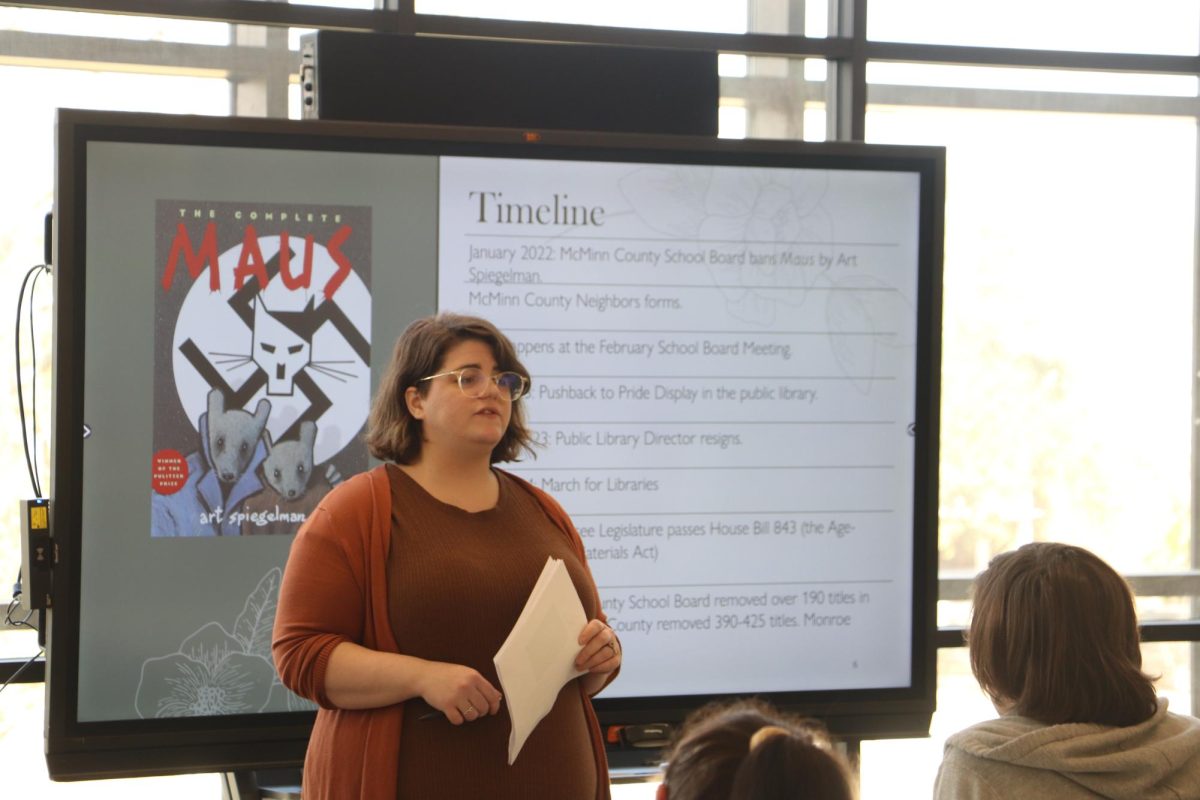
On March 3, the Sims Library head of acquisitions, Alex Sharp, held a discussion on censorship in the iHub.
Sharp, a former resident of Tennessee, discussed her experiences during several controversial book bannings a few years ago, as well as her protests of state legislation that codified the banning of books considered obscene or inappropriate.
“It’s just constitutionally against our rights as Americans,” Sharp said. The First Amendment allows every citizen to access and discuss information without interference from the government.
In her presentation, she used the graphic novel “Maus” by Art Spiegelman as an example. An award-winning graphic novel made for young adults, “Maus” was removed from an 8th-grade curriculum by the McMinn County Board of Education in a unanimous vote due to coarse language and a small depiction of nudity.
In doing so, the action gained national attention for being carried out right before International Holocaust Remembrance Day.
“It’s also impactful in the long term since you can actually limit the worldview of an entire population of people,” Sharp said. Many people, including the author, heavily criticized the move as insensitive and ignorant.
Even though the book was not banned, the situation encouraged watchdog organizations such as Moms for Liberty to campaign for the censorship of books they consider obscene or inappropriate.
According to Sharp, the last five years have seen a rapid increase in advocacy and legislation in favor of censorship, but she said she believes the roots go back as far as the 1980s.
Some attendees also had something to say about the issue at hand after the event was over.
“Censorship is sort of a fine line you have to walk,” said Gretchen Kahl, a sophomore English major. Kahl explained that while there is a controversial aspect to censorship, some forms do have a place in a society, especially when the material is intentionally explicit and inappropriate.
“Censorship for children is definitely important. But I think as far as adults go, we don’t need censorship in the adult realm,” said Baylie O’Bannon, a sophomore psychology major. She added that censorship itself lies in a morally gray area, making it hard to justify the arguments of supporters and opponents.
Many areas of society have a say in what censorship means. To some, censorship hinders the capacity to learn and foster intellectual discussion.
To others, censorship protects easily impressionable minds, like those of children, from potentially harmful and inappropriate material. No matter the case, censorship will remain a divisive and controversial subject in modern society.