
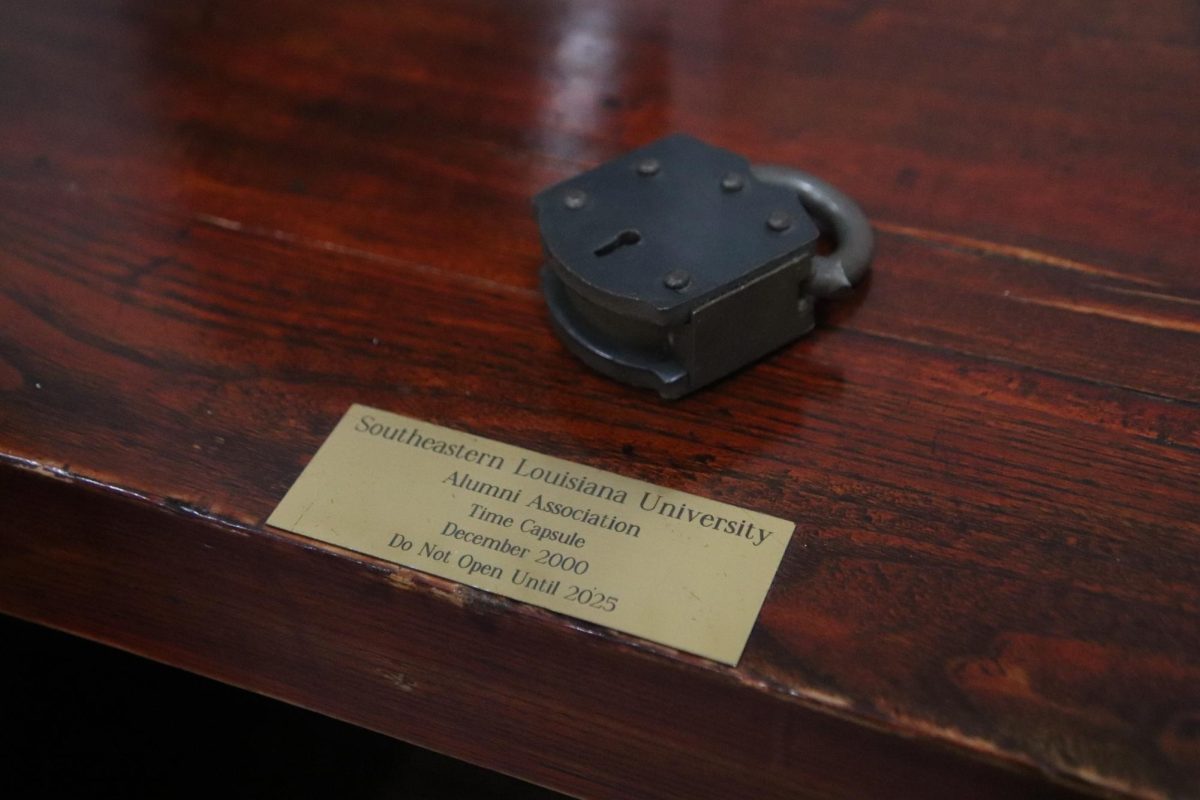
On Tuesday, Nov. 18, the Alumni Visitor Center hosted “Southeastern 100: Legacy Unsealed,” a dual celebration marking the opening of the 75th Anniversary Time Capsule Exhibition and the official launch of “Southeastern 100: The Story of Southeastern Louisiana University’s First Century.”
The limited-edition book chronicles the university’s century-long history.
Dr. Chelsea Slack, assistant professor of communication and media studies and the faculty adviser for The Lion’s Roar, authored the comprehensive history of the university’s most recent quarter-century (2000-2025).
Slack’s work updated the historical record originally chronicled by former English professor Ronald Harris, who wrote the history of the first 75 years in 2000. Sheri Gibson, assistant director for marketing and content, also served as an editor and author for the project, melding Harris’ past work with Slack’s new contributions to create a cohesive narrative.
Slack said that the history of this era was largely written through the lens of student media.
“The primary source of information for this section was thousands of pages of archival material, most of it from The Lion’s Roar student newspaper and Le Souvenir yearbook. These student-created records encompass the kinds of things that are often easy to overlook: construction updates, policy changes, campus events and student opinions,” she said.
Slack emphasized that the work created by Student Publications provided the necessary evidence to build the historical record.
“It is the most detailed, human account of how the university has grown and changed over the past 25 years,” Slack noted. “Ultimately, this history exists because our students chose to notice things, to ask questions and to leave a record.”
In addition to the student archives, the book incorporates local news coverage, press releases, planning documents and writing from the aftermath of Hurricane Katrina. However, Slack credited the students who worked in the newsroom as the driving force behind the narrative.
“This part of the book would not have been possible without the countless number of student journalists and writers who have walked the halls of our campus. Those who, in addition to their daily lives as students, took pen to paper, hands to keyboards and fingers to screens to write what has become Southeastern’s recent history. Their work lies at the very heart of this story,” Slack said.
The 2000-2025 section was a collaborative effort involving several The Lion’s Roar alumni.
Troy Granger, who served as a graduate research assistant for the project and is now an instructor in the Department of Communication and Media Studies, spearheaded the digitization of The Lion’s Roar archives for the past 25 years. Granger and Slack are currently considering grant funding options to potentially take all of The Lion’s Roar’s archives online.
“Doing research for the book taught me so much about the history of Southeastern and what the school has persevered through to become what it is today. It’s fascinating how the university has grown so much during its lifetime. It makes me proud to be an alumnus,” Granger said, adding, “I loved looking through the old newspapers.”
Recent alum Chase Gispert led the writing for the 2000-2025 sports section, an endeavor he began as part of the capstone course for his communication degree.
“In researching the past 100 years of Southeastern sports history, I learned a lot about the rich tradition we have here in Hammond, America,” said Gispert, the long-serving sports editor for The Lion’s Roar, who now holds the same position at the local Hammond Daily Star.
“SLU Athletics brings the local community together. From Strawberry Stadium to the University Center, there’s nothing like watching athletes in the Green and Gold representing Southeastern,” Gispert noted.
Student Publications Director Lorraine Peppo served as the ultimate fact checker and a seemingly endless well of institutional knowledge, extending back to even before her own time on campus. Former copy editors Hydee Holsapple and Jacob White also volunteered their time as graduate students to copyedit the text.
Piecing together these thousands of pages of student work meant sorting through a wide range of perspectives to make sense of the university’s larger story. It was through this process that the editors identified a recurring theme.
Gibson noted the stories collected throughout the book reflect Southeastern’s ability to recover from hardships, including wars, pandemics and turbulent political climates.
“And with each hardship, we’ve not only come back, but we’ve come back bigger, we’ve grown, and we’ve come back strong with even more impact,” Gibson said.
Alongside the book launch, the “Legacy Unsealed” exhibit offered attendees a glimpse into the daily lives of Lions from a quarter-century ago. The event showcased a unique, one-night-only exhibition of artifacts not part of the permanent collection.
While most items dated back to the 2000 sealing, curators Gibson and Trahan were shocked to discover a piece of history hidden inside that was much older: a belt buckle from between 1925 and 1927, when Southeastern was still a junior college.
Trahan, who compiled archived photos from the last 100 years, said he wanted the book’s images to show “100 years of joy” from students and faculty. He noted that visual history is just as vital as written history.
“I think that those pictures kind of tell the story just as much as the text does,” Trahan said.
Just as the photos and time capsule artifacts preserve specific moments in time, the written history relies on those who documented the daily life of the university as it happened. For the last 25 years, that record has been primarily maintained by student reporters, according to Slack.
“As the saying goes, ‘Journalism is the first rough draft of history.’ This quote sits at the bedrock of the journalistic ethos: to write is to bear witness; to write is to not be forgotten,” Slack said. “We write not for ourselves, but so that others may remember.”