
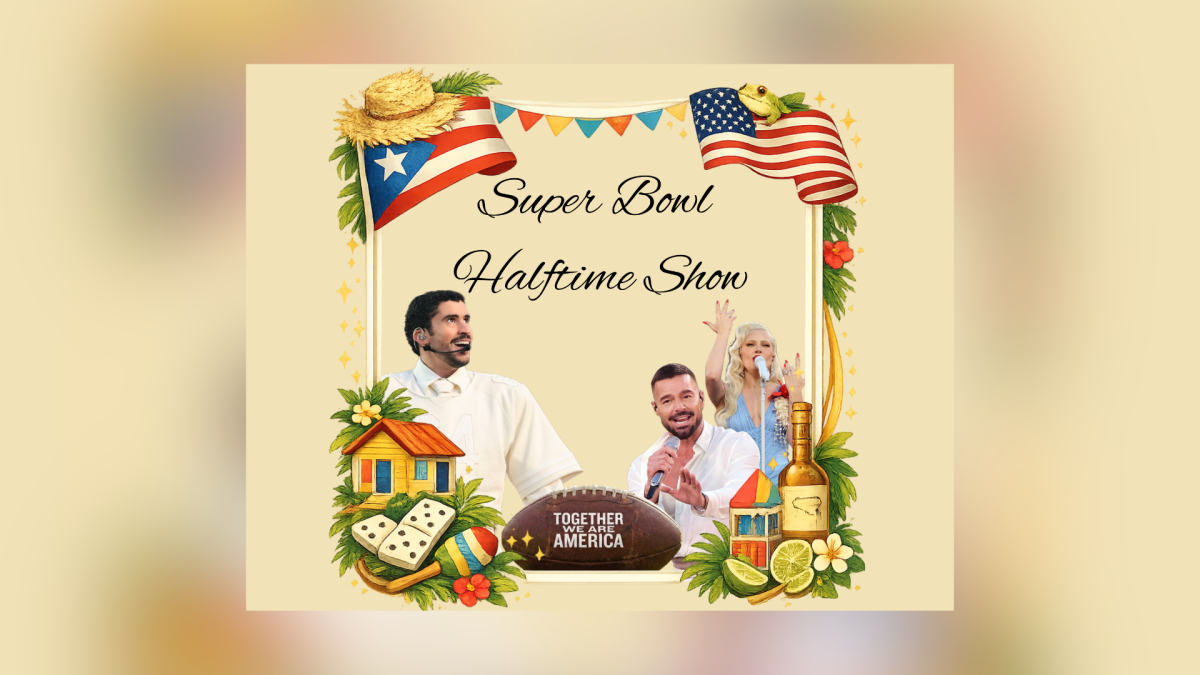
The Super Bowl halftime show, performed by Bad Bunny on Sunday, Feb. 8, at Levi’s Stadium in Santa Clara, California, was anticipated by everyone, including me, whether you agreed with his appearance or not.
Bad Bunny delivered a culturally centered, Spanish-based performance under the slogan “Together, We are America.” The show celebrated Latin American identity, focusing on love and community through a shared global language: music.
From the opening seconds, the energy was immediate. He opened the performance with “Tití Me Preguntó,” one of his best-known hits, in a set representing Puerto Rican culture while holding a football with the slogan written on it.
Bad Bunny moved through the stage, encountering small symbols of Latin culture: a coconut stand, elderly men playing dominoes and workers representing common Latino professions such as nail stylists and construction workers. For me, those details reflect what I associate with Latino culture, making the performance feel more familiar.
His iconic “casita” (“little house”) from his Puerto Rican residency was filled with different celebrities, including Cardi B, Pedro Pascal, Karol G, Jessica Alba, Young Miko, Ronald Acuña Jr., Alix Earle and Dave Grutman, at his “pari de marquesina” (“house party”).
It was a fascinating and effective way to capture viewers’ attention and bring together celebrities of different nationalities to celebrate the shared message: America’s culture.
A tribute to classic reggaeton appeared through short clips of hits such as “Dale Don Dale” by Don Omar and “Gasolina” by Daddy Yankee, followed by his 2020 hit “Safaera.” The inclusion made me scream with excitement and compare those historic reggaeton idols with Bad Bunny, realizing I consider him one of them.
An unexpected moment came with a real-life wedding. I initially thought it was part of the performance, but it turned out to be real. Eleisa Aparico and Thomas Wolter originally invited Bad Bunny to their wedding, and he invited them to celebrate it at the Super Bowl stadium. Can I be next?
A magical moment followed when Lady Gaga appeared, performing her hit collaboration with Bruno Mars, “Die with a Smile.” Now it makes sense why Lady Gaga shared a curious approach with Bad Bunny at the Grammys.
One of the most relatable moments came when Bad Bunny woke a child sleeping across three chairs during the party scene. Few images feel more familiar in Latino gatherings than a kid falling asleep in the middle of the celebration. I do not consider myself Latino, but I was born in Spain, and even I felt represented.
A reference to his Grammy Award for Album of the Year could not be left out, as it was the first time a mostly Spanish-language album received the honor. During his performance, Bad Bunny symbolically gave the award to his younger self, represented by a child dressed like him in one of his childhood photos.
The last celebrity invitation came from Ricky Martin, another well-known Puerto Rican artist in the Spanish-speaking community. Martin performed “Lo Que Le Pasó a Hawaii,” a Bad Bunny song, against a backdrop inspired by the cover of Bad Bunny’s album “Debí Tirar Más Fotos”.
My inner child could not stop jumping for joy at the reunion of two generations of Latino artists.
Lastly, Bad Bunny closed the show saying “God Bless America”, following the slogan by naming all the countries that form America and waving their flags. In particular, Bad Bunny waved around the original Puerto Rican flag, which was used before the U.S. colonized the island. Waving around the original flag used to be illegal.
“DtMF” was the final song, a track about memories and leaving home to build a better future. The performance could not have ended better, with love, unity and music. Even though I am European, I felt the unity of America as a continent and enjoyed every second of the performance, even getting emotional.
Bad Bunny’s concert was less a political vindication than a performance for the people, for love and for unity. As reflected on the big screen at Levi’s Stadium: “The only thing more powerful than hate is love.”